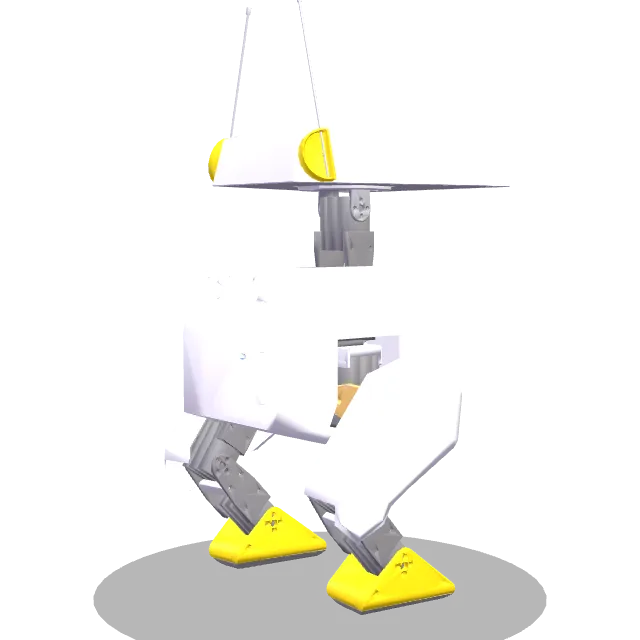
 Drag it: it's 3D
Walks and gets up
Sixteen motors and a trained brain: if it falls, it stands up by itself.
A robot duck the height of a bottle: it walks, gets back up on its own, recognises you, answers you. And behind it is all of Oravio OS, keeping it working even when you are away.
Tested, configured and already connected to Oravio OS: not a kit to finish, but a robot that works from day one. And you pay the price only when it is available.
The first to pre-order are the first to receive it.This is the real robot's model, part by part. Make it walk, make it wave, turn its head.
Sixteen motors and a trained brain: if it falls, it stands up by itself.
Its moves are neural networks: Oravio OS trains new ones, like dancing or following you.
Camera, microphone and voice: talk to it and it answers with Oravio's intelligence.
"When I get home, come to the door": you say it, Oravio writes the code and tests it.
Connected to your Oravio server, it patrols, alerts you, learns at night.
Open software: no black boxes, no subscriptions hidden in the robot.
A robot on its own does what it was programmed for. OravioDuck does what you ask, because it uses Oravio OS's hands: your phone, your server, your home, your email. Here is what you will be able to ask.
It walks around while you sleep and, if it sees someone, sends you the photo on WhatsApp.
At 7 it comes to you and tells you the weather, appointments and the emails that matter.
It learns a new move overnight, in simulation on your server, and can do it the next day.
It comes at the right time and, if you haven't taken it, texts you on your phone.
It chats with the children and every evening tells the parents how it went.
It greets, answers about products and saves the contacts of those who want a call back.
It learns to walk in simulation, millions of steps in a few hours, then does it in the real world. With Oravio OS you teach it new things in words.
Oravio OS is not an app: it is a system that works on your PC, your phone, an always-on server and inside its robots. You ask in plain words and it does it: a website, a program, protection, an automation that runs on its own. OravioDuck is its friendliest body.
| A robot on its own | OravioDuck with Oravio OS | |
|---|---|---|
| What it can do | what it was programmed for | what you ask in plain words |
| How it learns | a technician reprograms it | it learns overnight, on your server |
| How it reaches you | through its own app | WhatsApp, Telegram, email, phone |
| What it works with | itself | your PC, phone, home and programs |
| How many skills | its own | 188 Oravio OS hands, and more every day |
With the same Oravio OS subscription it builds custom websites and programs, protects your PC and home, designs circuit boards, draws 3D-printable objects and works while you sleep. OravioDuck uses them all.
You only pay for the Oravio subscription, which you use right away for everything. You don't pay for the robot now.
The robot: €349 in Italy, €389 in Europe and the rest of the world. You pay only when it is available, and only if you decide to get it.
The pre-order does not bind you or us to a purchase: only the subscription does, which you use right away and can cancel anytime. We contact you first as soon as OravioDuck is available. Details in the Terms, section 3. →
The project is open: you buy the parts, 3D print the body, and Oravio OS does the rest.
| Motion | Feetech STS3215 7.4V (servo bus seriale) | 14 |
| Brain | Raspberry Pi Zero 2 W | 1 |
| Brain | microSD 32 GB classe A1 | 1 |
| Sensors | IMU Bosch BNO055 | 1 |
| Motion | Adattatore bus servo seriale (USB-TTL half-duplex) | 1 |
| Sensors | Microinterruttori piede SS-10 | 2 |
| Power | Celle Li-ion 18650 3000 mAh 30 A | 2 |
| Power | Portabatterie 2×18650 + BMS 2S | 1 |
| Power | Regolatore UBEC 5 V 4–6 A | 1 |
| Power | Interruttore + connettori XT30 | 1 |
| Body | Filamento PLA ~500 g + TPU per i piedi | 1 |
| Body | Inserti filettati M3 a caldo | 1 |
| Body | Cuscinetti 6×13×5 mm | 3 |
| Voice and vision | Altoparlante 3 W + amplificatore, microfono, camera per Raspberry | 1 |
Indicative parts cost: €330–400. The body is printed with about 500 g of PLA.
This is how a duck robot like this one is assembled. With Oravio OS you don't have to figure it all out: it prepares the parts list and the prints, configures the motors, installs the software and walks you through it photo by photo. If you get stuck, ask "what now?".
Anyone looking for a walking duck robot ends up at the same starting point: a beautiful open project that asks for weeks of printing, assembly and tuning. Here are the answers you need before you start, and the shortest way to have it alive on your desk.
A small two-legged robot that moves like an animal: 14 serial bus servos (STS3215), a Raspberry Pi Zero 2 W as its brain, a BNO055 balance sensor and two switches under its feet. The body is 3D printed in PLA, with soft TPU feet. It does not walk by following hand-written steps: it learned how.
OravioDuck starts from the community project Open Duck Mini v2, released under the Apache-2.0 license, and brings it into Oravio OS: it arrives assembled and tested, with voice, vision, memory and real tasks, connected to your phone, your PC and your server. The open project stays open, and if you prefer you can build it yourself with our guide. OravioDuck is not an official product of that project.
The parts alone cost between €330 and €400: the 14 servos are the most expensive part, then the board, sensors, 18650 batteries and about half a kilo of filament. Add tens of hours of printing, assembly and tuning. OravioDuck assembled costs €349 in Italy and €389 in the rest of Europe and the world, and you only pay when it is available: today you pre-order it with an Oravio subscription.
The gait is born in simulation: a model of the robot tries thousands of times to stand and walk, and every successful attempt is rewarded (that is reinforcement learning). The result is a small network that runs on the Raspberry and corrects balance many times per second. With Oravio OS it learns new moves, like kicking a ball, without you writing code.
A regular 3D printer, a soldering iron and patience. Oravio OS prepares the parts order list, guides you step by step through assembly, installs the software on the Raspberry and helps you tune the motors. No programming needed: just ask, and Oravio does it.
No. You only pay for the Oravio subscription, which you use right away for all Oravio OS features. You buy the robot only when it is available and only if you want.
You are among the first to be contacted when OravioDuck is ready for distribution, with details and price in advance.
Yes, the subscription can be cancelled anytime from your account. The pre-order does not oblige you to buy anything.
Yes. The project is open: Oravio OS prepares the parts list and the 3D print files, configures the motors and installs the software.
No. You tell it in words what to do, and Oravio OS writes and tests the code for you.
It works with Oravio OS: it learns new things in words, reaches you on WhatsApp and Telegram, trains overnight on your server and works with your PC, phone and home.
The robot costs €349 in Italy and €389 in Europe and the rest of the world, payable only when available. Today you only pay the Oravio subscription, which you use right away for everything.
There is no delivery date yet: those who pre-order are the first to know and are contacted before anyone else.
Oravio plans already include an always-on server: that is where OravioDuck learns and works while you are away.
It is an open community project, under the Apache-2.0 license, for a small bipedal duck robot. OravioDuck adapts its hardware and software, assembles and tests it, and gives it the Oravio OS brain. It is not an official product of that project.
The parts cost between €330 and €400, plus 3D printing and several tens of hours of work. OravioDuck assembled and tested costs €349 in Italy and €389 in Europe and worldwide, and you only pay when it is available.
Yes. Walking is learned in simulation with reinforcement learning; with Oravio OS you ask for a new move and it tries it, learns it and remembers it.
A regular filament 3D printer: PLA for the body, about half a kilo, and soft TPU for the feet.
Yes: it brings together mechanics, electronics and artificial intelligence in an object that really walks. It can be built in class with the Oravio OS step-by-step guide, or delivered already assembled.
OravioDuck is based on open hardware and software projects licensed under Apache-2.0, adapted by Oravio. Apache-2.0 · Background videos are by third parties, shown with the YouTube player in privacy-enhanced (no tracking cookies) mode.
Pre-order today with the Oravio subscription: use all of Oravio OS right away, and when OravioDuck is ready we call you first.